Feb 12, 2026
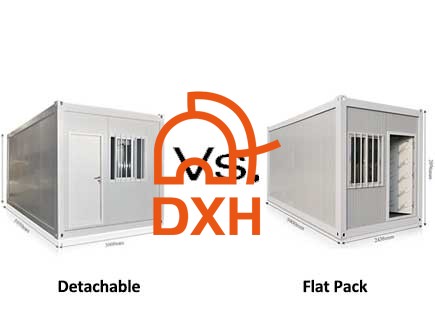
When exploring prefabricated container housing solutions, you'll have two popular options: Detachable Container Houses and Flat-pack Container Houses. While both types of prefabricated housing offer distinct advantages, they differ significantly in structural design, transportation methods, installation, and applications.
DXH House is a professional Chinese container housing supplier with over 10 years of experience manufacturing both types. We have delivered thousands of units to construction sites, commercial developments, and residential projects worldwide. This guide provides a comprehensive overview of everything you need to know, comparing them across multiple dimensions—including materials, construction processes, and cost-effectiveness—to help you quickly identify the prefabricated container building solution best suited to your needs.
What Are Detachable Container Houses?
Detachable container houses, also known as "quick assembly containers," are modular steel-frame structures designed for maximum flexibility and reusability. These units ship completely disassembled, with every component—columns, beams, wall panels, roof sections, and floor frames—packed separately and connected on-site using bolts and fastening screws.
Key Features of Detachable Container Houses:
Bolt-together Construction: No welding required during assembly or disassembly
Loading Capacity: 17-18 units per 40HQ
Reuse Capability: Can be disassembled and reassembled numerous times
Flexible Assembly: Columns connect to beams with visible carriage bolts
External Drainage: Rainwater drains through holes around the top perimeter
Installation Steps for Detachable Container Houses:
1. Prepare the foundation (concrete slab or pile foundation)
2. Sort components by type
3. Bolt together the base frame
4. Install corner posts and connect to the foundation
5. Secure wall panels to the frame
6. Install the roof frame and roof panels
7. Secure all joints and apply sealant
8. Install doors, windows, and interior finishes
9. Connect utilities (electricity, plumbing)
What Are Flat Pack Container Homes?
Flat-pack container homes enable rapid assembly of complete homes, offering easy relocation, convenient storage, and the ability to be reused multiple times as temporary housing. These units feature factory-welded top and bottom frames, with wall panels and other components shipped separately for on-site assembly.
Key Features of Flat Pack Container Houses:
Welded Frame Construction: Top and bottom beams are pre-welded to columns at the factory
Internal Drainage System: Built-in gutters and four drainage pipes route water through columns
Rigid Structure: Frame and beam combination provides superior stability
Flush Alignment: Internal hex bolts create seamless connections when stacking units
Weather-tight Design: Factory-welded components enhance waterproofing
Loading Capacity: 6 units per 40HQ
Installation Steps for Flat-Pack Container Houses:
1. Prepare the foundation and unpack the containers
2. Position the pre-welded base frame
3. Install corner posts and bolt them to the base frame
4. Hoist the roof structure onto the corner posts and secure it firmly
5. Install wall panels
6. Position and secure the pre-welded top frame
7. Install roof panels and doors/windows
8. Seal all gaps with silicone caulk
9. Complete interior finishing
10. Connect utilities
Comparison: Detachable vs. Flat Pack
Comparison Factor
Detachable Container Houses
Flat Pack Container Houses
Assembly Difficulty
Moderate - all components bolt togetherRequires careful alignmentMore connection points
Easy - fewer componentsPre-welded frames simplify process
Structural Stability
Good - relies on bolt tightness2-3 level stacking capacity
Excellent - welded construction3-4 level stacking capacity
Waterproofing
Good - external drainage systemRequires proper sealing maintenanceDrainage holes around perimeter
Excellent - integrated internal drainageFactory-welded componentsBuilt-in gutter system with column pipes
Reusability
Excellent - disassemble/reassemblePerfect for relocating projectsNo structural degradation with proper handling
Good - can relocate but more complex disassembly
Relocation Flexibility
Superior - designed for mobilityQuick breakdown and setupIdeal for temporary projects
Moderate - possible but more involvedPre-welded frames harder to transportBetter for permanent installations
Weather Performance
Good for moderate climatesRequires upgrades for extreme conditionsSuitable for most applications
Excellent for all climatesSuperior in harsh environmentsCoastal, desert, and snow-rated
Best Applications
• Construction site offices• Temporary worker dormitories• Mobile security booths• Event venues• Emergency shelters• Mining camps (1-5 years)
• Permanent residences• Commercial buildings• Schools & healthcare• Tourist resorts• Long-term worker housing• Quality-focused projects
Real-World Case Studies from DXH House
Case Study 1: Container Offices in Brazil
Project: The modular office comprises 355 containers, efficiently arranged to form offices, meeting rooms, public sanitary facilities, and auxiliary areas.
Choice: Detachable container homes
Case Study 2: Australian Townhouse Development
Project: Modern two-story residential community while avoiding humidity issues in coastal areas.
Choice: Flat pack container homes
Why Choose DXH House?
As a certified manufacturer since 2008, DXH Container House has delivered over 10,000 container housing units across 50+ countries. Our advantages include:
Quality Certifications: CE, ISO 9001, and regional building code compliance
Flexible Solutions: Both detachable and flat pack options available
Customization Service: Tailored designs for residential, commercial, industrial, construction, medical, school, and other specific projects
Technical Support: Free consultation, installation manuals, and on-site assistance available
Proven Track Record: Successful projects from the UAE to Australia, Xinjiang to Macao
Environmental and Sustainability Benefits
Both detachable and flat pack container houses offer significant environmental advantages over traditional construction:
Reduced Carbon Footprint: Factory production minimizes on-site waste
Energy Efficiency: Insulation options (EPS, rock wool, PU foam)
Material Reusability: Steel frames are 100% recyclable
Faster Construction: Less disruption to surrounding environment
Sustainable Design: Smaller footprint reduces land impact
Request a quote and let DXH House help you build better and faster with modular solutions.
Frequently Asked Questions
Can I Stack Multiple Container Units Vertically?
Both types of houses support vertical stacking. For projects with specific floor requirements, consult our structural engineers and ensure your foundation can bear the load.
Which Container House Is Best Suited for Extreme Weather Conditions?
For harsh climates with frequent high winds, heavy snowfall, or seismic activity, flat-pack container homes are the superior choice. Their welded frames provide greater structural rigidity and weather resistance. However, reinforced specifications of demountable homes also perform well in most scenarios.
Can These Container Homes Be Customized?
Both assembled and flat-pack homes offer extensive customization options, including:
- Interior layouts and partitions- Insulation material types (EPS, rock wool, PU foam)- Exterior wall finishes (wood grain, marble texture, solid colors)- Door and window styles- Electrical and plumbing configurations- HVAC systems- Bathroom and kitchen fixtures
Are These Modular Container Homes Suitable for Living?
Both housing types comply with CE, ISO 9001 standards, and local building codes in most regions. Key features include:
- Fire-resistant materials (Class A or B panels)- Seismic-resistant steel structural frame- Non-toxic interior materials- Comprehensive ventilation system- Electrical safety certification
What Foundation Options Are Available For These Modular Homes?
- Concrete slab foundation (most common)- Pile-beam foundation- Screw pile foundation- Strip concrete foundation
Foundation selection depends on soil conditions, local regulations, and project requirements. For temporary installations, concrete piles or screw piles offer faster installation and easier dismantling.
Do You Provide Installation Support For These Prefabricated Houses?
We offer multiple support options:
- Detailed installation manuals with photos- Assembly video tutorials- Remote technical consultation- On-site installation training- Full installation services (for large-scale projects)
Most clients with basic construction experience can install our equipment using our comprehensive guides.
Read More





 IPv6 network supported