Construction companies choose modular site offices because they provide a faster, more flexible, and more cost-effective alternative to traditional temporary buildings. Unlike traditional site-built offices, modular units are manufactured in a controlled factory environment, delivered ready for installation, and can often be operational within just a few days. Their ability to be relocated and reused across multiple projects also makes them a long-term investment rather than a one-time expense.
As project timelines shrink and labor costs rise, more contractors are moving away from traditional site-built offices in favor of modular buildings. This guide explains why modular site offices have become the preferred solution for construction companies worldwide. How they compare with traditional site offices, the key advantages they offer, where they perform best, and how to select the right modular office for your next construction project.
A modular site office is a prefabricated building manufactured off-site in a controlled factory environment, then transported and assembled at the construction site. Units are typically built on a steel frame with insulated sandwich panel walls, pre-installed electrical wiring, HVAC systems, doors, windows, and interior finishes already in place. Because the majority of work is finished in the factory, on-site installation is limited to foundation preparation, utility hookups, and final assembly. This process usually takes days rather than the weeks or months required for a site-built structure.
Modular site offices are commonly delivered in standard container dimensions (20ft or 40ft units) or as flat-pack folding units. They can be configured as single rooms, multi-room complexes, or stacked two-story office blocks. Typical features include:
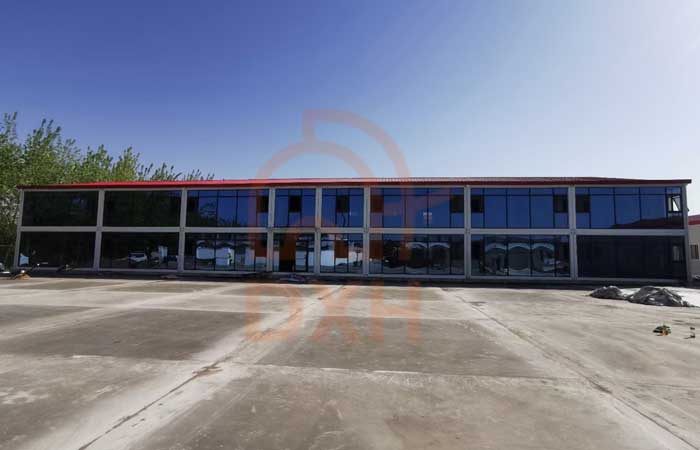
On large-scale infrastructure and commercial projects, contractors often need to establish a functioning site office before permanent facilities are available. Modular buildings allow project managers, engineers, procurement teams, and safety supervisors to begin work almost immediately after delivery, minimizing downtime during project mobilization. The following factors explain why modular offices have become the preferred choice across the construction industry.
Traditional site offices, built from concrete block or timber frame, typically take four to ten weeks to design, permit, and construct. Modular site offices can be manufactured in parallel with other early-stage site work and installed within two to seven days of arrival, allowing teams to move in almost as soon as the site is cleared.
Because modular units are manufactured in a factory using repeatable processes, material waste is lower, and labor is more efficient than in on-site construction. Contractors also avoid the cost of demolishing and disposing of a temporary structure at project close-out, since modular offices can be disassembled, transported, and reused on the next job.
Modular site offices are built around standardized units that can be combined, stacked, or reconfigured to match a project's changing needs. A single-room site office can be expanded into a multi-room administration block as a project scales up, and interior layouts — meeting rooms, private offices, open-plan work areas — can be customized without structural redesign.
Unlike a traditional site-built office, a modular site office is designed to be moved. When one project finishes, the same office can be disconnected, loaded, and transported to the next site rather than demolished.
Many construction projects now include sustainability targets. Traditional temporary offices often generate considerable material waste because they are demolished after project completion. Modular construction supports more sustainable site office delivery by emphasizing reuse rather than demolition.
Insulated panels and properly sized HVAC systems keep modular offices comfortable in extreme heat, cold, or humidity. A stable working environment supports staff productivity and retention on long-duration projects where personnel may be on-site for months at a time.
| Feature | Modular Site Office | Traditional Site Office |
|---|---|---|
| Installation Time | 2–7 days | 4–10 weeks |
| Manufacturing | Factory-built | Built entirely on-site |
| Mobility | Excellent | Permanent |
| Reusability | High | Very limited |
| Expansion | Easy to connect or stack | Requires new construction |
| Interior Comfort | Excellent insulation and customizable layouts | Depends on construction quality |
| Weather Impact During Construction | Minimal | High |
| Maintenance | Low | Moderate |
| Long-Term Cost | Lower over multiple projects | Higher |
| Best For | Medium- and long-term construction projects | Permanent temporary facilities |
Traditional site-built offices may still be appropriate for projects where relocation is unnecessary and long-term permanence is required. For contractors managing multiple projects, modular site offices provide the best balance between operational efficiency, employee comfort, and lifecycle value.
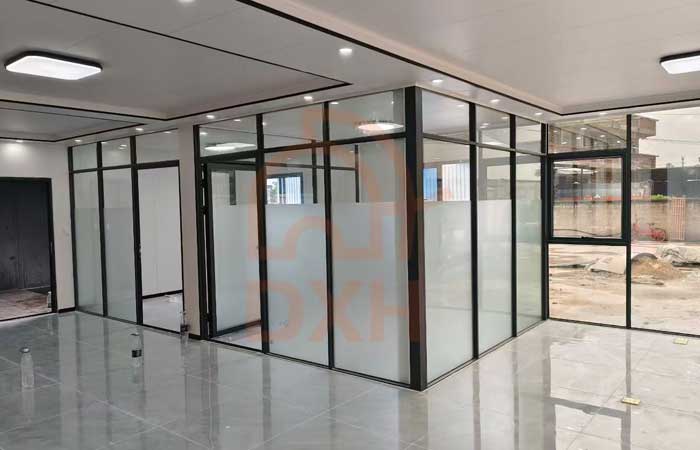
Although modular site offices are most commonly associated with construction projects, their flexibility and rapid deployment make them suitable for a wide range of industries. Below are some of the most common applications.
Commercial developments—including office buildings, shopping centers, hotels, hospitals, schools, and mixed-use developments—often require dedicated project management facilities throughout the construction process.
A modular site office provides a flexible workspace; additional modules can be added to accommodate larger project teams without interrupting ongoing operations.
Large infrastructure developments typically extend over vast geographic areas and remain active for several months or even years. They require a temporary site office to support engineering teams throughout different construction phases.
As modular offices can be relocated in step with project progress, they are particularly well-suited for linear infrastructure projects—situations where operations need to shift from one section to another.
Mining projects are frequently located in remote regions with limited infrastructure. Establishing permanent office buildings in these locations is often impractical, especially during exploration or temporary extraction activities.
Modular site offices can be combined with accommodation units, dining facilities, medical clinics, and storage buildings to form the administrative center of an entire mining camp.
Whether supporting oil fields, natural gas facilities, wind farms, solar parks, or hydroelectric developments, modular offices provide reliable workspace that can withstand challenging climates while maintaining comfortable working conditions.
Their rapid deployment is particularly valuable in fast-track energy projects where early project mobilization is essential.
Manufacturing companies frequently require temporary office space during factory expansions, equipment upgrades, warehouse construction, or production line modifications.
Rather than disrupting existing office operations, modular buildings provide dedicated project offices that remain operational throughout the construction period.
After project completion, the same buildings can be relocated to another facility for future expansion projects.
Government agencies often require temporary administrative facilities during public infrastructure improvements, emergency response operations, disaster recovery programs, or community development projects.
Modular site offices provide secure, rapidly deployable workspaces that can be customized for different operational requirements while supporting efficient public service delivery.
The rapid growth of renewable energy has created increasing demand for temporary project facilities (wind farms, solar power plants, battery storage facilities, and transmission infrastructure), which are frequently located in rural areas where permanent office buildings are lacking.
Modular offices provide engineering teams with modern workspaces throughout construction while remaining available for future renewable energy developments after relocation.
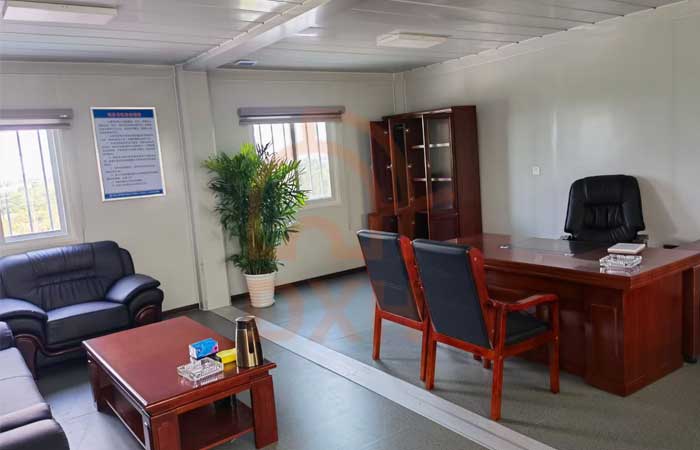
Every construction project has unique operational requirements. Choosing the right modular office depends on several factors beyond simply selecting a building size.
For short-term projects lasting only a few months, a compact modular office may provide sufficient workspace while minimizing transportation costs.
Projects extending beyond one year often justify investing in larger, more comfortable modular office complexes with meeting rooms, administrative spaces, and staff facilities.
The office should comfortably accommodate both current and future staffing requirements. Consider not only office employees but also visiting clients, subcontractors, inspectors, consultants, and project stakeholders.
Selecting a scalable modular system allows additional units to be installed as project teams expand.
Before selecting a modular office, contractors should evaluate:
For remote or difficult-access locations, flat-pack or highly transportable modular systems may reduce transportation costs while simplifying installation.
Projects located in tropical, desert, arctic, or coastal environments require different insulation specifications, HVAC capacities, and weather-resistant materials.
Choosing climate-appropriate construction materials improves energy efficiency while creating a healthier workplace for employees on-site.
Project management teams may expand or request meeting facilities. Rather than purchasing a fixed-size office, choose modular site offices specifically designed for future expansion.
Additional modules can be connected with minimal disruption, eliminating the need for costly reconstruction later.
Temporary offices should comply with applicable building regulations and workplace safety requirements within the destination country.
Working with an experienced manufacturer helps ensure the office satisfies both operational requirements and local regulatory expectations.
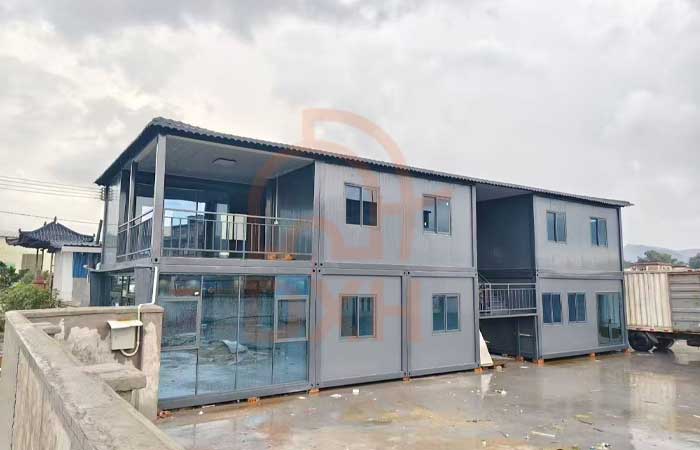
At DXH House, we specialize in designing and manufacturing modular building solutions that help contractors establish functional, comfortable, and reliable workspaces in a wide range of project environments.
Our engineering team works closely with customers to understand each project's unique requirements, including workforce size, climate conditions, transportation logistics, site constraints, and future expansion plans. This collaborative approach enables us to recommend practical solutions that support both current operations and long-term business goals.
Whether you require a compact office for a short-term construction project or a large administrative complex for a multi-year infrastructure development, DXH House is committed to providing modular solutions that improve efficiency, reduce lifecycle costs, and support successful project delivery.
If you're planning an upcoming construction project and exploring efficient temporary office solutions, DXH House is ready to help. Our team can work with you to develop a customized modular site office that meets your operational needs, complies with project requirements, and supports efficient project delivery from the first day on site.
Contact us today to discuss your project requirements or request a customized modular site office solution tailored to your business.
A well-designed steel-frame modular site office can typically remain in service for 20 years or more with proper maintenance. The exact lifespan depends on factors such as structural design, environmental conditions, transportation frequency, and routine maintenance. Because modular buildings are engineered for repeated relocation, many contractors successfully reuse the same office across multiple construction projects over their lifetime.
Yes. Relocation is one of the biggest advantages of modular construction. Unlike traditional temporary buildings, modular site offices are specifically designed to be dismantled, transported, and reinstalled with minimal structural impact. This makes them ideal for contractors managing multiple projects in different locations.
Yes. Modern modular offices can be customized for different environmental conditions by selecting appropriate insulation systems, HVAC capacity, corrosion-resistant materials, and structural reinforcement. Selecting the appropriate specifications ensures reliable performance under local climate conditions.
Not necessarily. Foundation requirements depend on local regulations, soil conditions, building size, and project duration. Many modular offices can be installed on concrete piers, strip foundations, steel supports, compacted gravel bases, and reinforced concrete slabs.
Capacity depends on the building configuration. A single office module may comfortably support two to six employees, while connected modular complexes can accommodate dozens—or even hundreds—of personnel across multiple departments. They can be connected or stacked, and office capacity can expand alongside project requirements.
Yes. Compared with traditional site-built temporary offices, modular buildings generally produce less construction waste, improve material utilization, and support repeated reuse.
Although installation time varies depending on building size and site preparation, most modular site offices can be installed within a few days after delivery. Because manufacturing occurs simultaneously with foundation preparation, the overall project timeline is significantly shorter than conventional construction.
Yes. Scalability is one of the defining characteristics of modular construction. As project teams expand, additional office modules can usually be connected with minimal disruption, allowing contractors to increase workspace without rebuilding the original office.

Xunqing Rd No.639, Taoyuan Town, Wujiang District, Suzhou City, Jiangsu Province, China
View All Contact


Our hours
Monday to Sunday: 9 AM - 6 PM
(all hours are Eastern Time)

 IPv6 network supported