If you've been looking for affordable, flexible housing or workspace solutions, a detachable container house might be perfect for you. But how exactly do they work — and are they the right choice for your project?
This guide breaks down everything you need to know: what a detachable container house is, how it's built and assembled, what it's made of, and who it's best suited for.
A detachable container house (also called a flat-pack container house or modular container home) is a type of prefabricated structure where the steel frame and wall panels are fastened together entirely with bolts and screws — no welding required. This means the entire structure can be taken apart, shipped flat, and reassembled at a new location as many times as needed.
Unlike traditional container homes that use recycled shipping containers, detachable container houses are built in a factory using galvanized steel frames and insulated sandwich panels. They're designed from the ground up to be portable, durable, and easy to customize.
Key difference: A detachable container house is not a converted shipping container. It's a new-build modular structure engineered specifically for easy assembly and relocation.
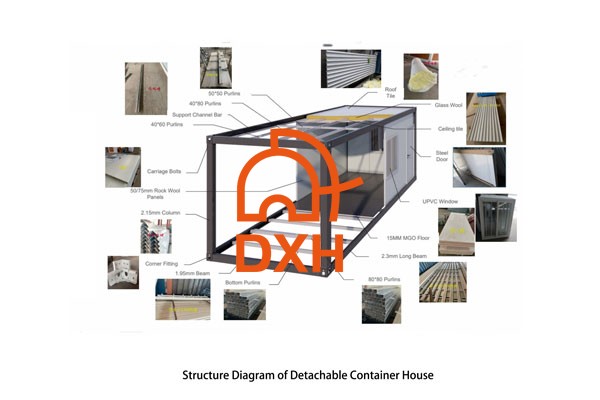
Every component — the steel columns, floor beams, wall panels, roof panels, doors, and windows — is precision-manufactured in a controlled factory environment. CNC machines cut and drill each part to exact tolerances, so every piece fits perfectly on-site without any improvised adjustments.
Factory production also allows for strict quality control. Each component is inspected and tested before it leaves the facility, which reduces the risk of defects compared to traditional on-site construction.
Once manufactured, the components are stacked and bundled into a flat-pack configuration for transport. A single standard truck can carry enough material for multiple units, making shipping far more cost-efficient than moving a fully assembled structure. The flat-pack format also means these units can be shipped worldwide. A 20-foot container can hold 7-8 standard sets, while a 40-foot high cube container can hold 17-18 standard sets.
Assembly on-site is designed to be straightforward. The process follows:
Typically, it takes only three to five workers using basic hand tools to assemble a standard 20-foot container home within a few days.
When the container home is no longer needed at a location, the process is reversed. Workers remove interior fittings, unscrew the panels and beams in sequence, and re-bundle the components for transport. Because nothing is permanently welded or glued, virtually all components can be reused across multiple deployments over many years.
The structural framework of the detachable container house is constructed from hot-dip galvanized steel profiles—typically Q235 or Q345 grade steel. The galvanization process provides a zinc coating that prevents rust and corrosion, extending the framework's service life to 15 to 20 years or more, even in harsh outdoor environments. The framework is meticulously designed to resist deformation caused by strong winds and seismic activity.
The panels forming the framework are sandwich panels: two layers of color-coated steel sandwiching an insulating core material. The three most commonly used cores are:
The steel outer skins are waterproof and weather-resistant. The sandwich construction provides both structural rigidity and insulation in a single slim panel, reducing the need for separate insulation installation.
High-tensile bolts, self-tapping screws, and proprietary locking connectors are used throughout. The fastener system is the defining feature of a detachable container house — it's what makes the structure fully reversible while still being structurally sound.
Thermal performance: Modern sandwich panels reduce heat transfer compared to uninsulated steel. Compared with bare wall structures, rock wool and polyurethane panels can reduce air conditioning and heating costs by 30% to 50%.
The detachable container home is well-suited to situations where a space solution needs to be deployed fast, then moved or repurposed later. Common applications include:
This is the most widespread use case. Construction companies deploy detachable container houses as worker dormitories, site offices, canteens, and tool storage. When a project finishes, the entire camp housing unit gets disassembled and redeployed at the next site. The speed of setup — often just a few days from truck arrival to move-in — makes them a practical replacement for slow-build brick dormitories.
Detachable container houses can serve as permanent homes in areas where traditional construction is too expensive, such as remote regions. They're also popular as backyard studios, guest rooms, and vacation cabins.
Businesses that need to establish a professional workspace quickly — on a remote project site, at a pop-up event, or as an overflow office — use detachable container offices for their combination of speed, professionalism, and relocatability.
The clean, modern aesthetic of a well-finished container unit makes it an attractive base for pop-up coffee shops, retail kiosks, exhibition booths, and ticket offices at events. The ability to move the unit when demand shifts is a major commercial advantage.
After earthquakes, floods, or other disasters, detachable container houses can be deployed within days to provide temporary shelters or field hospitals for displaced populations.
Compared to traditional construction, detachable container homes offer exceptional weather resistance and can be flexibly expanded by adding more removable modules (like creating an L-shaped studio?). This layout is ideal for:
Containers are more fire-resistant, pest-proof, and weather-resistant than wooden sheds. The modular nature of the detachable container means you can start with a single container and expand later by adding more units—creating L-shaped, multi-level stacked, or even hybrid garages with canopies.
This solution is ideal for:
DXH House (Suzhou Daxiang Container House Co., Ltd.) has been manufacturing prefab container houses since 2008 from a 60,000+ square meter production facility in Suzhou, China. With a daily production capacity of around 500 units and over 80,000 units sold annually, our customers are across the United States, Germany, Australia, Southeast Asia, the Middle East, and beyond.
Every detachable container house goes through a multi-stage quality control process — from raw material sourcing through precision CNC fabrication to final inspection. The result is a structure that meets the demands of construction sites, commercial operators, and residential buyers alike.
Customization options include exterior style (modern, industrial, or traditional), wall panel material, interior layout, window and door placement, and optional add-ons like solar panels, air conditioning units, and built-in furniture.
Whether you need temporary worker housing, a portable office, a permanent small home, or a commercial pop-up space, the detachable container house offers a rare combination of speed, flexibility, durability, and cost-effectiveness that traditional construction can't match.
Ready to get started? Contact DXH House to discuss your project requirements, get a custom quote, or request product specifications. Our team supports projects of all sizes, from a single 20ft unit to large-scale modular compounds.
While many detachable container homes serve temporary or semi-permanent purposes, their structural design can withstand permanent installation. You can add standard wiring, plumbing, insulation upgrades, and exterior cladding to make them indistinguishable from traditional small homes.
Prices vary based on size, wall panel specifications, interior finishes, and customization. Shipping costs, import duties, foundation work, and any custom upgrades are additional. Since container homes are factory-built in batches, the cost per square foot is significantly lower than that of site-built homes.
With proper maintenance, the galvanized steel frame can last 20 years or longer. Since the structure uses a bolted connection system, worn or damaged panels can be replaced individually without replacing the entire unit.
This depends entirely on your local jurisdiction and intended use. Temporary structures often require no permits, but permanent residential use typically requires zoning approval and building permits. Always verify local regulations before installation.
Detachable homes feature a modular design. Multiple units can be placed side by side or stacked vertically (typically up to three stories) and connected by shared walls, corridors, or stairwells to create larger complexes—dormitories, office campuses, or multi-room residences.

Xunqing Rd No.639, Taoyuan Town, Wujiang District, Suzhou City, Jiangsu Province, China
View All Contact


Our hours
Monday to Sunday: 9 AM - 6 PM
(all hours are Eastern Time)

 IPv6 network supported