Feb 28, 2025
Container homes have become an affordable housing solution. Whether you're looking for lower cost, the eco-friendly footprint, or the flexibility of modular living, there's a lot to like — but also a few real challenges worth understanding before you commit.
At DXH House, we've spent years manufacturing, customizing, and delivering container homes to residential buyers, commercial operators, and construction companies worldwide. This guide draws on that hands-on experience to give you an honest, complete picture of the pros and cons of container homes, what the numbers actually look like, and how the right design choices solve the most common problems.
What Is a Container Home?
Container homes are residential or commercial buildings constructed from modular steel structural units. DXH House's detachable container homes feature galvanized steel frames and insulated sandwich panels and are factory-prefabricated for easy assembly, relocation, and expansion without specialized tools. These factory-prefabricated modular container homes address the numerous challenges related to insulation, moisture resistance, and structural integrity that arise when converting old shipping containers.
All DXH House detachable container homes are manufactured at our factory in Suzhou, China, and shipped worldwide.
The Pros of Container Homes
1. Lower Costs than Traditional Construction
Since the main structure is prefabricated in a factory and arrives on site ready for final finishing, you can avoid labor-intensive and weather-dependent processes such as pouring foundations, erecting wall frames, and building from scratch. Labor costs account for approximately 30% to 50% of the total cost of a traditional home. DXH House’s modular container homes significantly reduce this percentage, thereby cutting down on labor hours and on-site management expenses.
2. Faster Construction Speed
Traditional residential construction typically takes 7–12 months, whereas a DXH House container home project—from order confirmation to on-site assembly—usually requires only 30–45 days for production and shipping, with on-site installation completed in just a few days.
This speed advantage is particularly important for commercial buyers (such as hotels, construction site accommodations, and pop-up retail stores), as the time to operational readiness directly impacts revenue.
3. Exceptional Structural Durability
DXH House container homes are constructed with high-strength galvanized steel frames that can withstand strong winds, earthquakes, and heavy loads. The bolted connection system allows for the replacement of individual components if damaged, and with proper maintenance, the overall lifespan of the structure can exceed 20 years.
4. Sustainability and Reduced Environmental Impact
At DXH House, all components are precision-cut using CNC machines in a controlled factory environment. Upon project completion, the structure can be disassembled, transported, and reassembled at a new location.
To further advance sustainable buildings, combined with proper energy-saving measures—such as spray foam insulation and solar panels—container homes can help reduce carbon footprints.
5. Flexible and Modular Design
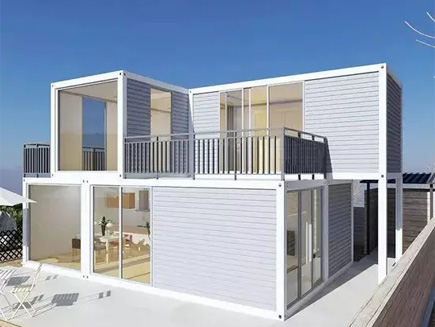
You can start with a single unit and add more as your needs grow. Container homes can be stacked vertically to create multi-story structures. Otherwise, you can arrange units in L-shaped, U-shaped, or linear configurations and connect separate units with walkways.
We offer modular container home layouts that can be expanded simply by adding more detachable container modules to connect seamlessly with adjacent units.
6. Portability and Relocation Capability
Unlike a traditional home, which is permanently attached to its site, a container home can be moved as you need. Whether a temporary project site or a future property investment, the ability to relocate the entire structure is a meaningful advantage.
DXH House's detachable container homes can be fully disassembled, loaded onto a standard flatbed truck, and reassembled at a new location.
7. Various Customization
Container homes offer high design flexibility beyond floor plan layout. You can customize exterior color and cladding style, interior flooring and bathroom finishes, window and door placement and size, insulation type and thickness, and add-ons including solar panels, air conditioning units, and built-in furniture.
DXH House design team works with each client through a structured customization process — from initial needs assessment through conceptual layout, material selection, and final blueprint review — before a single component is manufactured.
The Cons of Container Homes— and How DXH House Addresses Them
1. Space Limitations in a Single Unit
A standard 20-foot container offers approximately 160 square feet of interior floor space. A 40-foot unit roughly doubles that to 320 square feet. For buyers accustomed to conventional home sizes, a single container can feel restrictive.
The solution is straightforward: modular expansion. Multiple DXH House container units can be combined side by side, stacked vertically (up to three stories), or configured in custom arrangements to create living spaces that comfortably accommodate families of any size. Many of our multi-container residential projects exceed 1,000 square feet.
2. Insulation and Climate Control
Because container homes are made of steel, they have good heat and cold efficiency. If the container home lacks adequate wall insulation, this can lead to high indoor temperatures, and metal structures can become unbearably hot in the summer and bitterly cold in the winter.
The solution is straightforward: Modern container home manufacturing addresses this directly. DXH House uses insulated sandwich panels on all walls, floors, and roofs. These panels typically consist of a core made of rock wool or polyurethane combined with a finish such as stainless steel or color-coated steel, delivering thermal insulation performance comparable to that of traditional buildings.
Don't worry about this, our after-sales team provides each customer with insulation and heating solutions tailored to their specific region.
3. Rust and Corrosion Risk
Old containers may have surface rust, chemical contamination from previous cargo, or structural degradation — particularly in humid or coastal environments.
The solution is straightforward: DXH House's detachable container homes are new-build structures made from galvanized steel, not recycled containers. Galvanization provides a protective zinc coating that significantly slows corrosion. A well-maintained DXH House container home will retain its structural integrity for 20+ years.
4. Building Codes, Zoning, and Permitting
Regulations vary significantly by country, state, county, and municipality. In some jurisdictions, container homes are classified as temporary structures and face fewer restrictions; in others, they must meet the same building codes as permanent residential construction.
Key due diligence steps before purchasing include researching local zoning classifications for your intended site, confirming whether a building permit is required, checking HOA rules if applicable, and verifying that your intended foundation type is approved.
For permanent residential use in regulated markets, we recommend working with a local architect or contractor familiar with modular home codes in your area, and our team advises on international compliance.
DXH House has completed numerous container housing projects across residential, commercial, construction sites, and emergency housing. Our after-sales team provides long-term support, including quality assurance and prompt maintenance services for structural or functional issues.
View the DXH House project case studies to request a custom quote right now!
Ready to Build Your Container Home with DXH House?
If you're looking for a container home for residential, commercial, or project site use, DXH House offers the expertise, manufacturing capability, and after-sales support to take your project from concept to completion. We offer full custom design service: floor plan, interior finishes, exterior color, window/door placement, and add-ons.
Request a customized design consultation and pricing estimate. Our professional, technical, and after-sales support is available to answer your questions, guide you through the customization process, and support complete installation.
Frequently Asked Questions
Are Container Homes Durable Enough for Long-term Living?
Factory-prefabricated container homes with galvanized steel frames are specifically designed for long-term residential and commercial use. With standard maintenance (annual inspections and periodic repainting), these homes can last 20 years or longer.
How Much Does a Container Home Cost Compared to a Traditional Home?
The cost advantages of container homes primarily stem from lower labor costs and shorter construction times. Specific pricing depends on the home’s size, number of modules, interior configuration, and shipping distance. Please contact DXH House for a project-specific quote.
Can Container Homes Withstand Extreme Weather?
Steel-framed container homes can withstand Category 12 winds and seismic activity up to magnitude 8. The well-insulated sandwich panels also effectively resist extreme temperatures.
Do I Need a Building Permit for a Container Home?
This depends entirely on the regulations in your area and the intended use of the home (temporary or permanent). Shipping container homes for temporary use (e.g., construction sites, event venues, emergency housing) typically require only minimal permits. In regulated markets, shipping container homes intended for permanent residential use usually require a building permit and zoning approval. Please consult local policies before deciding to avoid unnecessary financial losses.
How Long Does It Take to Build a Container Home with DXH House?
On-site installation of a single container home unit typically takes one day; larger projects, such as container home resorts or multi-unit community developments, may take several weeks. This is significantly faster than the average 7–12-month construction timeline for traditional homes.
Can Container Homes be Expanded Later?
Yes, additional container units can be added to the side or top of an existing structure at any time without altering the original structure. A precision-engineered connection system ensures seamless integration between units.
Read More





 IPv6 network supported